Writing
AI didn't write this portfolio. My own archive did
How this whole collection was built. The model is a commodity; the proprietary archive and the judgment to shape it are the moat.
Here is the honest version of how the portfolio you are reading got built. I used AI to do it, and it did not write a word of substance that was not already mine. AI did not supply the ideas, the stories, or the judgment. It took five years of my own writing and a career’s worth of real decisions and made them legible at a speed I could never hit by hand. The model is a commodity anyone can rent. The thing that made this work was the input, and the input was mine.
I want to be transparent about the whole process, because the process is the point.
What I actually did
I started by feeding an AI my real history. A full export of five years of my work Slack, more than twenty thousand of my own messages. My old LinkedIn posts going back to 2018. The actual decisions I made building a company. Then I ran a pipeline that looks like this.
First, analyze the voice. The AI measured how I actually write, my median sentence length, the fact that I ask more questions than I make statements, the words I lean on, the punctuation I avoid. That became a style guide, written from evidence, not guesswork.
Second, mine the themes. It read the archive for the moments where I was actually teaching something, coaching a team, making a hard call, and surfaced them as candidate ideas.
Third, draft at scale. For each idea, it produced a first draft grounded in the specific Slack thread or decision it came from.
Fourth, and this is the part that matters most, verify. Every claim was checked against the real source. No invented numbers. A hard voice standard enforced on every line. A grammar pass on every piece.
The diagram below shows the whole pipeline.
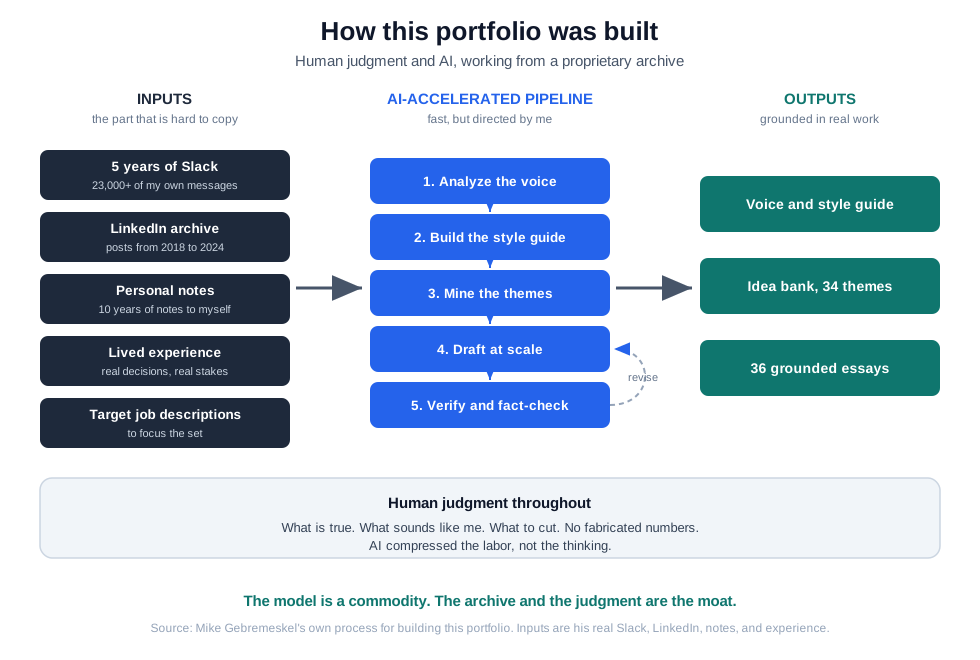
How this portfolio was built. The inputs on the left are the part that is hard to copy.
The model is a commodity. The archive is not.
Here is the insight I keep coming back to. Anyone can open the same AI I used. The model is available to everyone for a few dollars. So the model is not the advantage. If you point it at a blank slate and a generic prompt, it gives you generic mush that reads like everyone else’s.
What it cannot give you is a deep, specific body of real work to draw from. Point the same model at twenty thousand of your own messages, a decade of your own decisions, and your own lived experience, and it does not give you mush. It gives you back yourself, organized and at speed. The advantage was never the AI. It was the proprietary substance I fed it, and the judgment to shape what came out.
That reframes the whole anxiety about AI making everyone sound the same. AI only flattens you if you have nothing specific to say. If you have a real archive of real experience, AI is the opposite of a flattener. It is the fastest way to surface what is already uniquely yours.
The human half was the whole job
Because the AI handled the typing, the work became almost entirely judgment. Hundreds of small calls that no model could make for me.
Which moments were actually meaningful versus just frequent. Which sentences sounded like me and which sounded like a press release. What was true and defensible versus a number I could not stand behind. What to cut. Where a draft was technically fine but missed the real lesson. I set the guardrails too. No fabricated metrics. Every claim tied to a source I could point to. A voice specification strict enough that a wrong-sounding line stuck out.
That is the part people miss about working with these tools. AI scales whatever standard you give it. Give it a low bar and it produces a lot of slop quickly. Give it a high bar, real inputs, and constant judgment, and it produces a lot of good work quickly. The output tracked my standards, not the model’s defaults.
Why this was even possible
There is a quiet lesson underneath all of this. The only reason an AI could mine five years of my thinking is that I had written five years of my thinking down. For years I put my reasoning into Slack messages and docs instead of letting it evaporate in meetings. I did not do that so a machine could read it later. I did it because writing things down made my teams faster. But it had a second payoff I never planned for. It compounded into an asset.
Most people’s thinking disappears. The decision gets made, the context is lost, and a year later nobody remembers why. Mine accumulated into a searchable record of how I actually think and work. When the tools finally caught up, that record was sitting there, ready to be turned into something. Capture compounds. Your future self, holding better tools, will thank the version of you that bothered to write it down.
So is it still mine?
The fair question is whether using AI like this makes the work less mine. I do not think it does, and the reason is the split I keep describing. The substance is mine. The judgment is mine. The lived experience is mine. AI compressed the labor of turning all of that into clean prose. It did not compress the thinking, because the thinking had already happened, over years, in real rooms with real stakes.
If anything, being open about this is the credibility, not the weakness. I am not pretending a machine made me a better thinker. I am showing that I had a real body of work and the judgment to shape it, and that I know how to use modern tools to move fast without lowering the bar. That last part is not a confession. In this market, it is the skill.
The takeaway is not “use AI to write your portfolio.” It is something more durable. The value in the AI era is not the model, which everyone has. It is having something real to feed it and the judgment to shape what comes back. Your accumulated, specific experience is the moat. AI just makes it finally legible at scale.
So the question I would ask you is the one I had to ask myself. If you pointed the best AI in the world at your own archive tomorrow, would it find a deep body of real work to draw from, or a blank page? The answer to that is mostly written years before you ever open the tool.
A note on this collection: each essay is dated to the period its lesson comes from, so the set reads as a body of work built over a career. This capstone is the exception, written in the present to be honest about how the collection itself was assembled.
June 2026