Writing
Teach your team to think in outcomes
A real goal passes one test: so what changes if we hit it?
Your team’s goals are probably a to do list with a fancy name. Here is the test I use. Read a goal, then ask, “So what?” What changes if we hit this? If the answer is nothing, it was never a goal. It was a task.
I learned this the slow way, by sitting with my team every week and rewriting our goals together until they actually meant something.
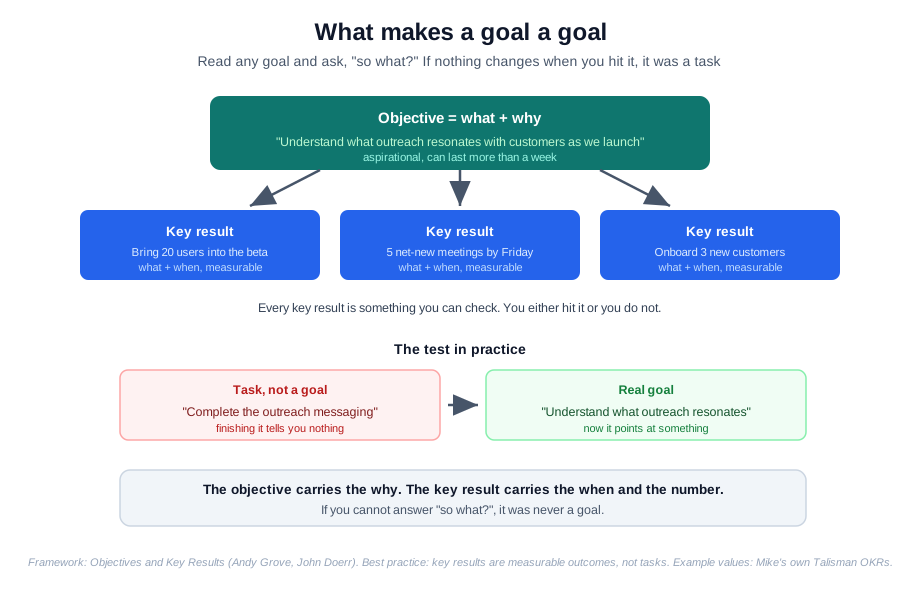
The objective carries the why. The key result carries the when and the number. A task becomes a goal when it can answer “so what?”
Where it started
We did not pick up OKRs from a book. They were a tenet of Techstars. We went through the program, and I was expected to have our objectives and key results ready to present to investors and our cohort every week for the full three months. When you have to stand up and defend your goals to a room of investors every single week, you learn fast which goals are real and which ones fall apart the second someone asks why it matters.
So when the program ended, I brought the practice in house. But here is the catch with any framework. It is easy to adopt the format without the thinking behind it. People started filling in the boxes with whatever they were already doing.
Here is a clear example. One week our objective was written as “Complete the outreach messaging.” It looks productive. But I pushed on it, because finishing a task tells you nothing about whether it worked. As I put it to the team, “simply completing the outreach messaging doesn’t mean we get customers or that it works.” You can finish it and learn nothing.
So I started correcting these, one line at a time, in the open where everyone could see the reasoning.
The two corrections I made over and over
The first was about objectives. People wrote objectives that did not lead anywhere. So I would ask for the reason behind it. As I told the team, the objective “needs a reason why it is being done.” So “Complete the outreach messaging” became “Understand what type of outreach messaging resonates with customers most as we release the product.” The work underneath is the same. But now it points at something. There is a “so what.”
The second was about key results. People kept writing activities instead of measures. A key result like “Understand what messaging is working and what is not” sounds fine until you ask, “How would we know when we hit it?” You cannot. So I would hand back the measurable version. Something like “Bring 20 more users into the beta,” because that is specific and you either hit it or you do not. The rule I kept repeating was simple. Key results “refer to things that are tangible or can be measured.”
I tried to make the two roles clear. The objective carries the what and the why. The key result carries the what and the when. If you could not answer “why” for the objective, or “when” for the key result, you were not done writing it.
The dunk
The part people got stuck on was that objectives are allowed to be big. They were writing tiny, safe objectives so they could be sure to hit them, which defeats the point.
So I gave them an analogy I actually used. Objectives can last more than one week and should be aspirational. My example was wanting to throw down a dunk in a pickup game without hurting myself. That is the objective. It is a stretch and it is clear. The key results are the things you do this week to get there. Train, jump, build up. The objective inspires. The key result measures.
That landed better than any framework definition I could have given them. Pick the image that fits your team. The point is to free the objective to be ambitious and pin the key result to something real.
I built a rhythm so it would stick
A good idea dies without a ritual around it, so we built one.
We ran a weekly ops review. Everyone posted their OKRs ahead of time. We took a few minutes to read silently and leave comments, then we discussed until we were aligned. I would check in a few minutes before the meeting to offer help so the meeting itself went smoothly.
I also set two house rules that I cared about as much as the goals themselves. Celebrate when you hit a key result early, because it means you can aim higher next time, and that is good information. And call it out when you aimed impossibly high, because that is a signal too. It tells us to get you help or rethink what is in the way. Missing a goal was not a failure to hide. It was data to discuss.
One more reframe I had to make a lot. When a hard metric showed we were behind, people read it as criticism. I did not. I told a teammate that a tough metric might be the best one we have, because it is telling us we need to move faster, not that anyone is incapable. A good metric is honest with you. That is the whole job.
We outgrew the spreadsheet and moved the whole thing onto a Notion board with columns for the key result, the objective, the goal, and the final result. The tool changed. The habit did not.
What I actually believe about this
The framework was never the point. Plenty of teams run OKRs and still write task lists dressed up in OKR clothing. The thing that mattered was teaching people one reflex. After every goal, ask, “So what?” What is different in the world if we pull this off?
If you can answer that, you have a goal. If you cannot, you have a chore, and no template will save it.
Try it on your own list this week. Read each item and ask, “So what?” I think you will be surprised how many do not survive the question.
December 2025