Writing
The Foogin' Standards: building a culture of excellence
Building a culture of excellence, inspired by how Arteta rebuilt Arsenal. Standards written down, held by everyone, even when it costs you.
A team only becomes excellent when its standards are three things at once: written down, expected of everyone, and held even when holding them costs you something. I built that into my product team at Talisman, and I gave it a cheeky name. The Foogin’ Standards.
The name and the whole idea came from outside my industry, and that was the point.
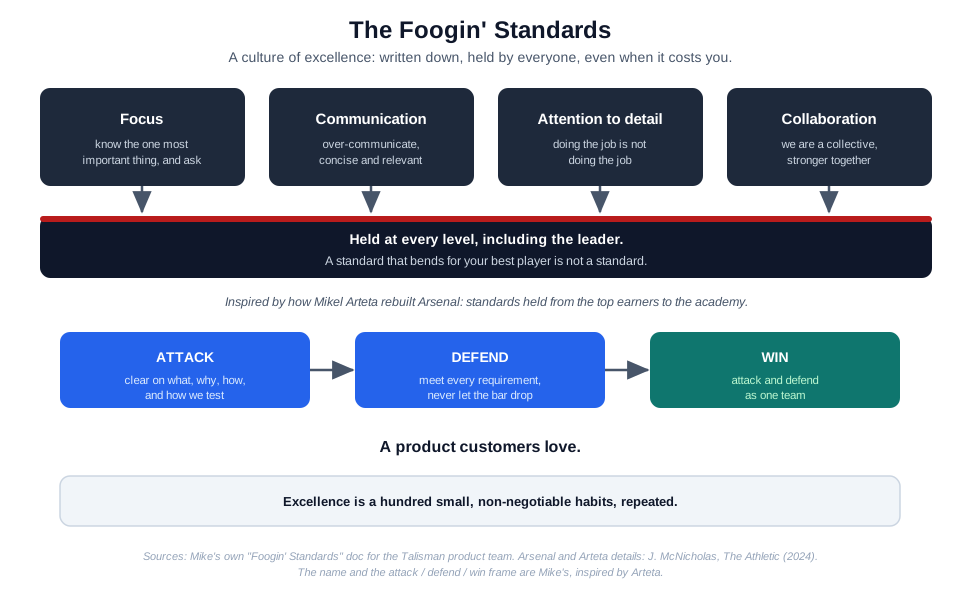
Four values, held by everyone, expressed as attack, defend, and win. Inspired by Arteta’s Arsenal.
Where the name came from
I am an Arsenal fan, and Mikel Arteta is a role model for me in how he builds. When Arteta took over Arsenal in 2019, the club had fallen from its heights. He turned it around by installing a set of standards from day one that everyone had to meet, from the highest earners to the academy kids. The ones who would not meet them, even big stars, were moved on. As The Athletic put it, those who continually fell short were dispensed with, which led to high-profile exits.
“Foogin’” is how the phrase “f***ing standards” sounds in Arteta’s Spanish accent. I borrowed it on purpose, because it captured the energy I wanted. Not corporate, not soft, just a clear bar and the will to hold it.
Here is the deeper move, though. I did not get this from a management book. I got it from soccer. Inspiration can and should come from outside your domain. A football club and a software company are not as different as they look. Neither can be carried by one person. Both need a group in sync, holding a standard, to win.
What the standards actually were
I did not just declare “have high standards” and hope. I wrote down what they meant, in plain terms the whole product team could act on.
We had four core values. Focus, so each person knew the single most important thing to do and how they fit into it, and asked when it was not clear. Communication, because over-communicating, when it is concise and relevant, means fewer mistakes and less rework. Attention to detail, because simply doing the job is not doing the job, and a feature that reaches a customer at low quality is a failure for the whole team. And collaboration, because none of us could do our part well without knowing our teammates, their strengths, and their gaps.
Then I made the expectations concrete and non-negotiable. If you see an issue in the live product, you create the ticket. You do not ignore it. If something you are handed is not right, you raise it with your teammate and escalate if needed. You do not ignore it. If you are blocked, you say so immediately, and if you are blocking someone else, you clear it within a day. If you see a teammate’s message, you respond within the hour during your working hours. And before you hand a question to someone else, you spend the ten minutes to try to answer it yourself, so you are not passing your cognitive load onto the team.
None of this is fancy. That is the point. Standards that are vague are not standards. They are wishes.
Why they have to apply to everyone, including the leader
The hard part of standards is not writing them. It is holding them when it costs you, especially with your most important people.
This is what I admired most in how Arteta did it. He held the line with stars like Mesut Ozil and Pierre-Emerick Aubameyang, and as one former staffer told The Athletic, winning those battles did not undermine his authority, it enhanced it. The team always came first. A standard that bends for your best player is not a standard. It is a suggestion.
And it runs upward too. Arteta is, by the accounts in that piece, relentless about questioning himself, looking in the mirror, and getting better. I tried to hold myself to the Foogin’ Standards before I asked anyone else to. You cannot demand a bar you will not meet yourself.
How we framed it: attack, defend, win
To make it stick, I used the soccer frame directly. We attack by being clear and concise about what we are building, why, how we build it, and how we test it. We defend by meeting every customer requirement, constantly raising the bar for the experience, and never letting our standards drop. And we win by attacking and defending as one team. Excellence is not a moment. It is a hundred small, non-negotiable habits, repeated.
Culture is not the values poster. It is the bar your team actually holds in the small moments, every day, especially when no one is forcing them to. You make that real by writing the standards down, applying them to everyone equally including yourself, and being willing to pay the cost of upholding them.
Arteta gave me the blueprint, and a great name. What outside your own field could give you the blueprint for the team you are trying to build?
From my own “Foogin’ Standards” doc, written for the Talisman product team:
“Without standards, clear expectations, and accountability at every level we will never build a product customers love and turn 0s and 1s into functional art that solves real needs… simply doing the job is not doing the job. If a feature gets to customers and isn’t quality, it is a sign of failure for the entire product org.”
Sources: my own “The Foogin’ Standards” document, written for the Talisman product organization. The Arsenal and Arteta details are from James McNicholas, “How Mikel Arteta rebuilt Arsenal in his own image,” The Athletic, 2024 (the standards held at every level, the Ozil and Aubameyang exits, Arteta’s self-reflection and obsession with improvement). The “Foogin’” name and the attack / defend / win framing are mine, inspired by Arteta.
September 2024